Eric L. Piza, Nathan T. Connealy, Savannah A. Reid, and Christianna M. Palermo
Journal of Criminal Justice (2025)

Key Takeaways
- Automated vehicle locator data used to measure patterns of discretionary police patrol in Manchester, NH
- Discretionary patrol is unevenly distributed throughout the city
- Over 50% of street segments in the city had a high trajectory discretionary patrol level
- Significant clusters of both discretionary patrol hot spots and cold spots observed throughout the city
- Discretionary patrol hot spots were associated with heightened levels of traffic-related calls for service
- Discretionary patrol hot spots were not associated with heightened crime levels
- Better aligning discretionary patrol with crime hot spots may enhance crime prevention efforts
Research Summary
Place-based policing has been supported by decades of research demonstrating that crime is highly concentrated in small areas and that proactive policing can reduce crime when resources are strategically deployed. However, these strategies rely heavily on the assumption that officers have enough discretionary time available to act proactively. Prior research on police discretion has identified that a substantial portion of officer time is discretionary, but these estimates vary widely across studies and have seldom been mapped spatially.
The study uses Automated Vehicle Locator (AVL) data from the Manchester, NH Police Department. AVL technology uses GPS pings to record the exact time and location of police vehicles, typically every 10–30 seconds. The dataset covers January 2022 through December 2023 and includes more than 9.7 million AVL pings. Each ping records whether the vehicle was responding to an assigned call for service (committed time) or not (uncommitted or discretionary time). The researchers aggregated these data to the street segment level, resulting in 5,878 unique units of analysis across the city.
The analysis proceeded in three stages: 1) Group-Based Trajectory Modeling (GBTM) classified street segments into groups with similar monthly patterns of discretionary patrol time over the 24-month study period; 2) Anselin Local Moran’s I identified statistically significant spatial clusters (hot spots and cold spots) of discretionary patrol time, and; 3) Multinomial Logistic Regression: examined which crime, call-for-service, and neighborhood variables predict the likelihood of a street segment being part of a high-high (hot spot) or low-low (cold spot) discretionary patrol cluster.
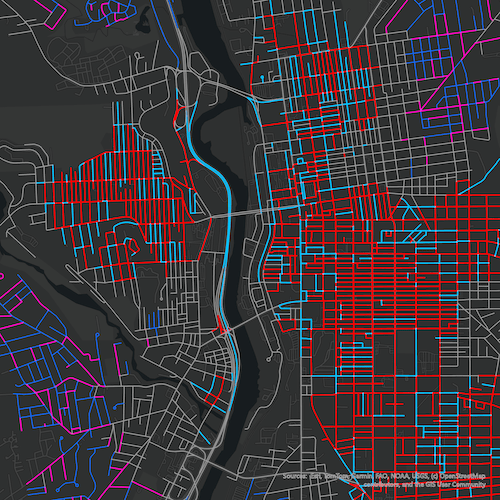
The trajectory modeling identified three distinct groups of street segments: High discretionary time (55% of segments, averaging 50% of patrol time as discretionary), medium discretionary time: (26%, averaging 38%), and low discretionary time (19%, averaging 36%). This indicates that, on average, officers spend about half of their patrol time in uncommitted, discretionary activity. However, this availability is not uniform across space.
The spatial analysis found that high-discretionary street segments tended to cluster in Manchester’s downtown and along major thoroughfares. These areas exhibited high-high clusters of discretionary patrol time, while low-low clusters appeared around the periphery of the city. Interestingly, many low-discretionary segments were adjacent to high-discretionary segments, revealing fine-grained variation even within short distances.
None of the crime variables—including total crime, violent crime, or property crime—significantly predicted high-high discretionary patrol clusters. This suggests that areas where officers spend the most uncommitted time do not necessarily overlap with areas of highest crime. In other words, patrol availability and crime concentration appear misaligned. Only traffic-related calls for service were positively associated with high discretionary clusters. This may indicate that officers frequently engage in traffic enforcement during discretionary periods, which is consistent with previous research showing that vehicle stops are the most common proactive activity among patrol officers.
Areas with higher concentrated disadvantage and greater ambient population were more likely to be high discretionary hot spots, while areas with higher levels of theft were less likely to have high discretionary time. The findings suggest that police patrol availability correlates more with environmental features and mobility patterns than with direct crime measures.
The results carry important implications for both research and practice in policing. The study challenges the core assumption of place-based policing that officers naturally have the time and flexibility to engage in proactive crime prevention where it is most needed. From a policy perspective, AVL data could be a powerful tool for improving patrol allocation. With real-time tracking, supervisors and dispatchers could identify where officers have available discretionary time and redirect them toward high-crime areas or areas with heightened community demand.
 Eric L. Piza, Ph.D.