Eric L. Piza, Cassie McMillain, and Daniel Trovato
Journal of Research in Crime & Delinquency (2026)

Key Takeaways
- Ballistic evidence (NIBIN hits) reveals spatial links between gun violence hot spots
- A single large gun violence network spans much of the city, with 53% of street segments with NIBIN evidence connected to each other
- The gun violence network reflects patterns of hot spot homophily, with gun violence hot spots more likely to connect to other hot spots
- Hot spot homophily remains statistically significant even after controlling for geographic proximity, neighborhood demographics, built environment features, and police enforcement activity
- Because gun violence hot spots are interconnected, intervening in highly connected hot spots can generate residual deterrence effects that ripple through the broader network
Research Summary
The criminology of place has long established that crime is not evenly distributed across a city. A small minority of geographic hot spots account for a disproportionate share of criminal activity. Despite this well-documented concentration, most crime-and-place research implicitly treats hot spots as independent, self-contained units. Environmental criminology, including crime pattern theory, has long emphasized that the interconnectedness of places shapes how crime opportunities are presented to motivated offenders. A social network lens offers a promising way to formalize and test these interconnections empirically.
This study analyzes patterns of gun violence in Kansas City, Missouri, leveraging data from the National Integrated Ballistic Information Network (NIBIN). NIBIN collects ballistic imaging data from spent projectiles and cartridges recovered at crime scenes or test-fired from seized firearms. When ballistic evidence from the same firearm is recovered at two different locations, NIBIN generates a “hit” — a confirmed link between those two places.
NIBIN hits are used to construct a geographic network of gun violence in Kansas City. Our analytic sample includes 1,701 street segments connected by 2,248 edges derived from 1,349 unique crime guns with at least one NIBIN hit from 2014 to 2019. Street segments are then classified as hot spots, low gun crime, or no gun crime places.
Exponential random graph models (ERGMs) test whether hot spots are disproportionately connected to one another. This method compares the network’s structural patterns against thousands of randomly simulated networks to determine whether observed patterns exceed random chance. Models include a range of control variables covering geographic proximity, the built environment, neighborhood demographics, police enforcement, and endogenous network processes.
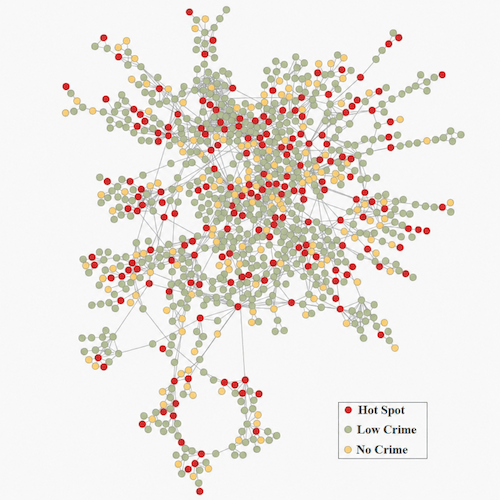
Over half of all street segments with NIBIN evidence belong to a single large connected component. This indicates that gun violence in Kansas City is not fragmented across isolated pockets but is structurally linked across a substantial portion of the city’s geography. Visual inspection of the network confirms that hot spots tend to cluster in the central core of this connected component, while lower-crime segments occupy the periphery.
Gun violence hot spots exhibit strong homophily — that is, they are significantly more likely to be connected to other hot spots than would be expected at random. When two street segments are both hot spots, the odds that ballistic evidence from the same crime gun appeared in both locations increases by approximately 43–47%. This pattern, which we term hot spot homophily, holds consistently across all model specifications. A separate set of mixing models further confirms that connections between pairs of hot spots are significantly more likely to occur in the observed network than any other pairing — hot spot to low gun crime street segment, hot spot to no gun crime crime street segment, or two low crime street segments.
This study advances the criminology of place by demonstrating that gun violence hot spots are not self-contained but are embedded within an interconnected geographic network. These findings have meaningful implications for place-based policing. If hot spots are interconnected, then successfully intervening in a highly connected hot spot may produce spillover prevention effects throughout the broader gun violence network. Law enforcement can leverage NIBIN data to prioritize intervention sites, focusing on places that serve as central hubs in the gun violence network.

