Eric L. Piza, Claire Harkins, and Katherine P. Hazen
Criminology & Public Policy (2026)

Key Takeaways
- Geofencing and clean graffiti media campaigns in Mecklenburg County, NC significantly increased 311 calls (a proxy for citizen engagement), but did not reduce violent crime
- About 61% of geofence sites and 47% of clean graffiti sites fell outside the priority high-violence zip codes, showing implementation missed many high-risk areas
- Campaign exposure produced about 0.20 more 311 calls per census tract per month, or roughly 470 additional calls, driven mostly by request-related calls such as work orders and repairs
- Neither campaign produced significant effects on its own
- The alert conscience technique of situational crime prevention may be less effective than approaches that physically modify the environment
- Media campaigns may need to be paired with other prevention strategies to reduce crime
Research Summary
Situational crime prevention (SCP) aims to reduce crime by changing the immediate environment in ways that limit criminal opportunities. Evaluations generally show that SCP produces modest but meaningful crime reductions, but that evidence draws mostly from “hard” techniques such as target hardening, access control, and surveillance. Much less is known about alert conscience, which seeks to awaken a potential offender’s moral conscience at the moment they are deciding whether to commit a crime. Examples include “shoplifting is stealing” signs, speed-feedback displays, and media campaigns that communicate the consequences of crime to change community norms.
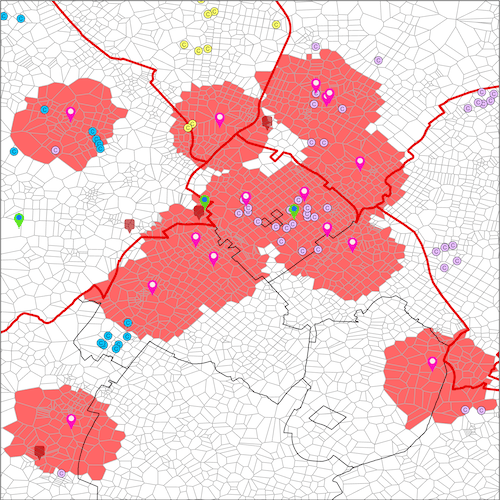
We sought to help fill this gap by evaluating a media-based violence prevention media campaign in Mecklenburg County, North Carolina. Alongside traditional billboards, the campaign used two place-based approaches. Geofencing used virtual geographic boundaries to deliver “Not Another” anti-gun-violence images to mobile devices, averaging about 3.5 million impressions per deployment. Clean graffiti involved power washing “violence free zone” messages onto neighborhood sidewalks.
We tested the effect the campaign had on citizen engagement and on violent crime. We measured engagement through 311 calls for service, which prior research links to community custodianship and civic-mindedness, divided into feedback-related calls (such as complaints) and request-related calls (such as work orders). We measured violent crime as homicides, assaults, robberies, and weapons offenses.
We applied a staggered difference-in-differences design, which accounts for interventions introduced in different places at different times. We analyzed 60 months of data at the census tract level, controlling for seven covariates, including pre-intervention outcome levels, billboard proximity, concentrated disadvantage, demographics, public transit, ambient population, and location in a priority zip code.
Campaign exposure led to a statistically significant increase in 311 calls, an average of 0.20 additional calls per treated tract each month, or more than 470 additional calls overall. Request-related calls drove most of the increase, while feedback-related calls showed no significant change. When analyzed separately, neither geofencing nor clean graffiti produced significant effects, indicating the increase depended on the combined campaigns. In contrast, the campaign had no significant overall effect on violent crime or any of its subcategories.
We considered three explanations for the lack of effect on violence. First, the assumed theory of change, in which messaging shifts norms and then behavior, may be flawed, or evaluations like ours may not adequately measure the intervening mechanisms. Second, violent crime usually arises from interpersonal conflict and may be less responsive to moral nudging than property crime. Third, implementation may have undermined the campaign. Although the Office intended to focus on five zip codes accounting for over half of homicides, about 61% of geofence locations and 47% of clean graffiti locations fell outside these priority areas, and many missed micro-level hot spots.
These findings suggest media campaigns can generate community engagement but may be less effective at reducing crime than techniques that directly modify the physical environment. Pairing alert conscience campaigns with other SCP techniques may be necessary to affect crime, and future campaigns should concentrate on the highest-violence places and run across more of the year.

