Geographic Networks of Gun Violence: Exploring Hot Spot Connectivity through Ballistic Evidence and Social Network Analysis

Eric L. Piza, Cassie McMillain, and Daniel Trovato

Journal of Research in Crime & Delinquency (2026)

Key Takeaways

  • Ballistic evidence (NIBIN hits) reveals spatial links between gun violence hot spots
  • A single large gun violence network spans much of the city, with 53% of street segments with NIBIN evidence connected to each other
  • The gun violence network reflects patterns of hot spot homophily, with gun violence hot spots more likely to connect to other hot spots
  • Hot spot homophily remains statistically significant even after controlling for geographic proximity, neighborhood demographics, built environment features, and police enforcement activity
  • Because gun violence hot spots are interconnected, intervening in highly connected hot spots can generate residual deterrence effects that ripple through the broader network

Research Summary

The criminology of place has long established that crime is not evenly distributed across a city. A small minority of geographic hot spots account for a disproportionate share of criminal activity. Despite this well-documented concentration, most crime-and-place research implicitly treats hot spots as independent, self-contained units. Environmental criminology, including crime pattern theory, has long emphasized that the interconnectedness of places shapes how crime opportunities are presented to motivated offenders. A social network lens offers a promising way to formalize and test these interconnections empirically.

This study analyzes patterns of gun violence in Kansas City, Missouri, leveraging data from the National Integrated Ballistic Information Network (NIBIN). NIBIN collects ballistic imaging data from spent projectiles and cartridges recovered at crime scenes or test-fired from seized firearms. When ballistic evidence from the same firearm is recovered at two different locations, NIBIN generates a “hit” — a confirmed link between those two places.

NIBIN hits are used to construct a geographic network of gun violence in Kansas City. Our analytic sample includes 1,701 street segments connected by 2,248 edges derived from 1,349 unique crime guns with at least one NIBIN hit from 2014 to 2019. Street segments are then classified as hot spots, low gun crime, or no gun crime places.

Exponential random graph models (ERGMs) test whether hot spots are disproportionately connected to one another. This method compares the network’s structural patterns against thousands of randomly simulated networks to determine whether observed patterns exceed random chance. Models include a range of control variables covering geographic proximity, the built environment, neighborhood demographics, police enforcement, and endogenous network processes.

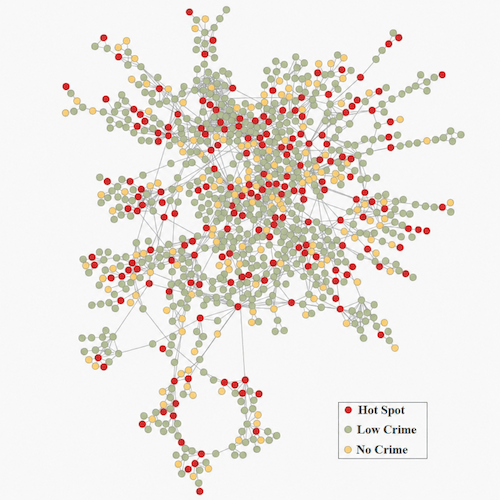
Over half of all street segments with NIBIN evidence belong to a single large connected component. This indicates that gun violence in Kansas City is not fragmented across isolated pockets but is structurally linked across a substantial portion of the city’s geography. Visual inspection of the network confirms that hot spots tend to cluster in the central core of this connected component, while lower-crime segments occupy the periphery.

Gun violence hot spots exhibit strong homophily — that is, they are significantly more likely to be connected to other hot spots than would be expected at random. When two street segments are both hot spots, the odds that ballistic evidence from the same crime gun appeared in both locations increases by approximately 43–47%. This pattern, which we term hot spot homophily, holds consistently across all model specifications. A separate set of mixing models further confirms that connections between pairs of hot spots are significantly more likely to occur in the observed network than any other pairing — hot spot to low gun crime street segment, hot spot to no gun crime crime street segment, or two low crime street segments.

This study advances the criminology of place by demonstrating that gun violence hot spots are not self-contained but are embedded within an interconnected geographic network. These findings have meaningful implications for place-based policing. If hot spots are interconnected, then successfully intervening in a highly connected hot spot may produce spillover prevention effects throughout the broader gun violence network. Law enforcement can leverage NIBIN data to prioritize intervention sites, focusing on places that serve as central hubs in the gun violence network.

Officers’ body cameras all fell off during violent arrest. Phoenix doesn’t know how much it happens

Despite tens of millions of dollars spent on the technology, the Phoenix Police Department does not track how often officers’ body cameras fall off during use-of-force incidents.

ABC15 asked the city if it kept data on “body-worn camera dislodgements” while reporting on a violent and controversial arrest that appears to be set to end up as a federal lawsuit.

A Phoenix police spokesperson said it does not and does not believe it’s a concern.

Eric L. Piza Appointed Lipman Family Professor of Criminal Justice

On February 2nd, Northeastern University celebrated the installation of Eric L. Piza as the Lipman Family Professor of Criminal Justice. The endowed professorship recognizes Professor Piza’s leading scholarship in evidence-based policing, place-based crime prevention, and the use of technology and data in criminal justice—and strengthens the School of Criminology and Criminal Justice’s commitment to research that informs policy and practice.

The Lipman Family Professor of Criminal Justice is an endowed position made possible by the Lipman family’s support for Northeastern’s School of Criminology and Criminal Justice. When the fund was established, it specified that the occupant of the chair be an outstanding and distinguished scholar in criminology and criminal justice. Ben Lipman, a graduate of the College of Criminal Justice and a former member of the Northeastern University Corporation, represented the Lipman family at the installation event.

KC wants to keep funding gunfire detection system. But has it reduced crime?

The Kansas City Police Department continues to request funding for a gunshot detection technology that research shows has not reduced shootings or improved case clearance rates. While the technology has not improved clearance rates or reduced shootings, research has shown that it has improved response times and evidence recovery.

Here Be Dragons: Burdens of Knowledge and Innovation in Evidence-Based Policing

Eric L. Piza

Evidence Base: Criminal Justice Research, Policy and Action (2026)

Key Takeaways

  • Evidence-based policing must evolve beyond “what works” to provide more value to police practitioners
  • Innovation is constrained by the growing “burden of knowledge” that typifies developed sciences
  • Further innovation requires deeper and more resource-intensive research to generate meaningful advances
  • The real-world impact of evidence-based strategies depends more on implementation quality, organizational capacity, and local context than on program design alone.
  • Sustaining evidence-based policing requires investment in a broader knowledge infrastructure that integrates evaluation, implementation science, and officer-level data into routine decision-making

Research Summary

This essay argues that evidence-based policing (EBP) has reached a critical inflection point. Decades of rigorous research have clarified which policing strategies can reduce crime, but this success has also produced new challenges. The accumulation of knowledge has created a “burden of knowledge,” making further innovation harder and leaving many aspects of policing practice poorly understood. I contend that the next phase of EBP must move beyond asking what works and focus instead on how, why, and under what conditions policing strategies succeed or fail.

Research has consistently shown that proactive strategies outperform reactive ones, that focusing resources on high-risk places and people is more effective than spreading them broadly, and that problem-oriented approaches outperform generic enforcement. Systematic reviews now provide strong evidence supporting strategies such as hot spots policing, problem-oriented policing, and focused deterrence. As a result, policing is no longer a low-information environment.

Ironically, this growth in evidence has widened the gap between research and practice. Police agencies often struggle to implement evidence-based strategies effectively, even when strong evidence exists. The “burden of knowledge” mechanism explains that as a field matures, advancing it requires greater effort and more complex forms of inquiry. In policing, what police leaders increasingly need is guidance on implementation, adaptation, organizational capacity, and local context.

The essay does not argue for abandoning rigorous impact evaluations. Rigorous designs remain essential for determining effectiveness. However, an exclusive focus on causal outcomes risks stifling innovation by privileging a narrow set of research questions and methods. Further advancement requires a second generation of evidence-based policing built on a broader knowledge infrastructure.

A second-generation EBP should have three priorities.

First, implementation science is essential for understanding how evidence-based practices are adopted, adapted, and sustained in real-world agencies. Factors such as leadership, organizational culture, resources, officer motivation, and external pressures strongly shape outcomes and must be studied systematically.

Second, EBP must better track officer activity. Without knowing what officers actually do on the street, agencies cannot determine whether outcomes reflect strategy design or execution. Technologies such as body-worn cameras and automated vehicle locators provide unprecedented opportunities to study officer behavior, treatment dosage, and police–community interactions.

Third, scholars should better embrace basic and descriptive research. Exploratory, diagnostic, and qualitative studies often generate the foundational knowledge that enables innovation, even if they rank lower on traditional methodological hierarchies.

In conclusion, evidence-based policing stands at a pivotal moment. The easy questions about what works have largely been answered, but the harder work of understanding how policing functions in practice remains. Addressing this challenge requires embracing methodological diversity and treating implementation, context, and officer behavior as central to evidence-based policing’s future.


Pokémon cards bring business — and thieves

When Ron Zeida woke up in the middle of the night to a barrage of texts, he knew something was wrong.

On Dec. 1, a burglar broke into his Vanguard Comics store in Barnstable and swiped roughly $1,000 worth of merchandise from the shelves. In under a minute, the thief left the store’s glass door shattered and its tight-knit community shaken. Three weeks later, police are still combing for leads, Zeida said.

But given the range of merchandise that Vanguard carries, it could have been much worse.

Anxiety Over Pace of Brown University Shooting Investigation Mounts As Search For Killer Continues

In a city where police can tap live feeds of hundreds of surveillance cameras, the identity of the Brown University campus shooter remained unknown to the public Monday evening as the community mourned the two students who were killed and rallied around the nine others injured on Saturday.

But newly released images and the offer of a reward signaled authorities were intensifying a manhunt as much as they could without knowing which man they are hunting.

Research Mirrors Cleveland Reports that ShotSpotter Helps Police Respond To Gunshots But Doesn’t Reduce Crime

Growing national research shows that the gunshot detection system used in Cleveland helps police respond to shootings but does little to reduce crime or improve case outcomes.

A new report by Cleveland State University, released Friday, reviewed 87,000 ShotSpotter alerts, surveyed officers and residents and examined how the technology is used.

Is ShotSpotter Effective? Gunshot-detection technology can help police departments if they use it properly.

Facial recognition. Drones. Police have adopted a range of new technologies in recent years to help prevent and respond to crime.

Yet some of the most intense controversies still swirl around a product that’s been around for decades: gunshot-detection technology (GDT), most prominently ShotSpotter, which now operates in roughly 170 cities.

ShotSpotter uses an array of acoustic sensors to listen for loud noises, identify those likely to be gunfire, and alert law enforcement. Despite the system’s straightforward premise, several cities—most notably Chicago—have discontinued its use, citing concerns about effectiveness and racial disparities.

Judge orders agents in Chicago area to wear bodycams, adding she’s “startled” over violent clashes

A federal judge in Chicago has ordered immigration agents in Chicago to wear body cameras on duty, after raising concerns about agents’ use of tear gas against protesters.

U.S. District Judge Sara Ellis said her order would require any federal agents working under Operation Midway Blitz to wear body-worn cameras and keep them on during “law enforcement activities.” Details of the order were still being worked out ahead of another hearing in the case next week.