Welsh, B., Piza, E., Thomas, A. and Farrington, D. (2020)
Journal of Contemporary Criminal Justice, 36(1): 56-69

Research Brief
Open Access Post Print
Published Article
PAGE UNDER CONSTRUCTION: Article description to be added soon.
Lipman Family Professor | School of Criminology & Criminal Justice | Northeastern University

Welsh, B., Piza, E., Thomas, A. and Farrington, D. (2020)
Journal of Contemporary Criminal Justice, 36(1): 56-69
Research Brief
Open Access Post Print
Published Article
PAGE UNDER CONSTRUCTION: Article description to be added soon.
by Piza, E. and Baughman, J.
Redlands, CA: Esri Press. (In Progress, Under Contract)
PAGE UNDER CONSTRUCTION: Book description to be added soon.

Kennedy, L., Caplan, J., Piza, E. and Thomas, A. (2020)
Homicide Studies, DOI: 10.1177/1088767920976183
Abstract:
In this paper, we explore the conditions under which clearance rates improve by
looking at the experience across New York City. Using one agency provides a control
on the administrative differences that appear across other jurisdictions that have
been studied, usually through cross-national analysis. Our analysis uses Risk Terrain Modeling (RTM) to identify environmental features that relate to closed versus open homicide cases using two years of New York City Police Department (NYPD) data. This analysis is supplemented with an investigation of precinct-wide social structure variables to examine how context matters in influencing closure rates.

Police reform is everywhere in the news, and everyone has a different perspective on the issue, from activists to police practitioners to politicians. John Jay Associate Professor of Criminal Justice Dr. Eric Piza is a former crime analyst who studies both police reforms — like the impact of body-worn cameras on police effectives — and the manner in which those reforms are undertaken. He emphasizes the importance of program evaluation in the area of police reform: “Far too often, people talk about implementing specific reforms without acknowledging whether or not we have a sufficient evidence base to know whether those reforms will bring about the intended effects.”

Cutting the NYPD police budget by $1 billion is not enough for protesters and advocacy groups, but three criminologists from the city’s John Jay College of Criminal Justice said defunding the police is not going to be easy.
“Defunding the police is kind of one of those generic terms that means different things for different people,” said Dennis Kenney a criminal justice professor at John Jay College and a former Florida police officer. “Shutting down the NYPD would be a bit of a disaster. They’re talking about somebody else taking over the responsibilities that the police handle.”
Advocates and protesters contend that allocating funds to social services could improve mental health, addiction and homelessness in different communities, and that it is a better use of taxpayer money…

Village police department approves body cameras for officers…

State officials don’t have a current count of how many police agencies in New Jersey use body cameras, but a survey by New Jersey Advance Media found that officers in four of our 10 most-populated towns don’t have them.
Police departments in New Jersey and around the nation have rushed to outfit officers with cameras in recent years, but the expense is a primary reason why many departments go without. The cameras themselves may cost a few hundred bucks each, but the annual bill for operating these systems can run in the hundreds of thousands…
Sytsma, V., Connealy, N. and Piza, E. (2021)
Crime & Delinquency, 67(1): 27-57.
Study Abstract
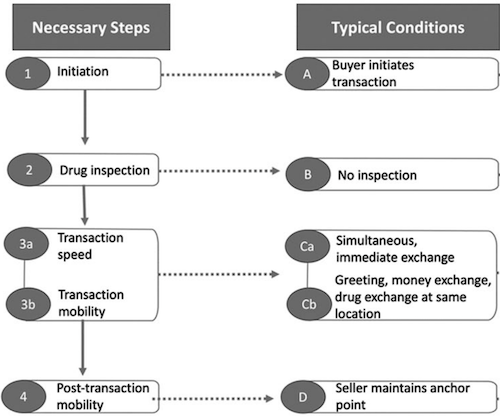
The extent to which environmental context has been considered when developing crime scripts has been limited to descriptions of the locations offenders visit during the crime. This research contributes a description of the environmental characteristics of an open-air drug market and identifies environmental facilitators and inhibitors toward offender actions during a drug-selling crime script. Closed-circuit television (CCTV) camera footage is combined with Google Street View images to determine whether physical disorder, decay, and “crime generators” characterize the drug market under study. There is little evidence to suggest that the former two dimensions influence the crime sequence; however, crime generators such as retail facilities and bars and liquor stores are environmental facilitators toward a drug-selling crime script; and transit locations, corner stores, and public parks are environmental inhibitors toward the script.
Hatten, D. and Piza, E. (2020)
Crime & Delinquency. DOI: 10.1177/0011128720922545
Abstract
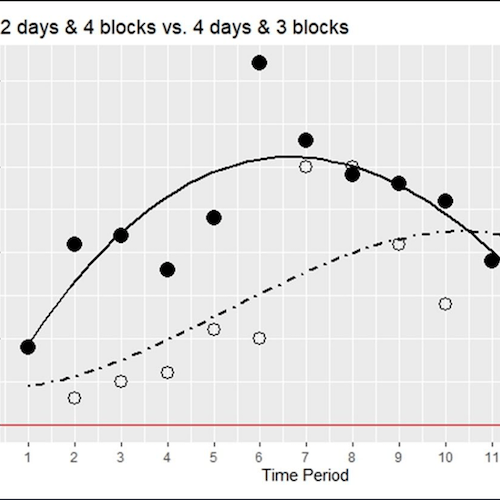
This study investigates the temporal stability of identified near-repeat robbery patterns in Newark, New Jersey. With one noteworthy exception, scholars have yet to explore the temporal stability of identified spatiotemporal crime clusters. Furthermore, researchers have yet to measure the near-repeat phenomenon longitudinally. To fill this gap, this study employs a longitudinal design to measure variation in effect size and significance of identified near-repeat crime patterns across 13 “rolling” one-year time periods within a 2-year study period (January 2015–December 2016). Temporal instability was found within two out of six spatiotemporal crime clusters. Results are reported in the form of formalized descriptive statistics and visualizations of temporal trends.
Sytsma, V. and Piza, E. (2020)
Policing: A Journal of Policy and Practice, 14(2): 526-541
PAGE UNDER CONSTRUCTION: Article description to be added soon.
Have a WordPress.com account? Log in now.

