South Side Weekly: CPD Stats on ShotSpotter Full of Holes, Experts Say

A report by the Chicago Police Department (CPD) that said officers respond more quickly to ShotSpotter alerts than 911 calls doesn’t make a convincing argument for keeping the technology, according to experts who reviewed it. Eight university professors specializing in data science, sociology and criminology said the report lacked a number of key statistical measurements, and several questioned the accuracy of the report’s response time data.

Ald. David Moore (17th Ward) and other City Council members who are advancing an ordinance that would allow them to keep ShotSpotter in their wards requested the data from CPD. The ordinance, which the Reader reported was written with help from a ShotSpotter lobbyist, would also direct CPD to collect data on the number of shell casings and weapons recovered as a result of alerts. On April 1, the Committee on Police and Fire advanced the ordinance to the City Council, setting up a clash with Mayor Brandon Johnson, who announced in February that the City’s contract with ShotSpotter will expire in November. Moore did not respond to a request for comment…

Commonwealth Beacon: ShotSpotter in the Cross Hairs

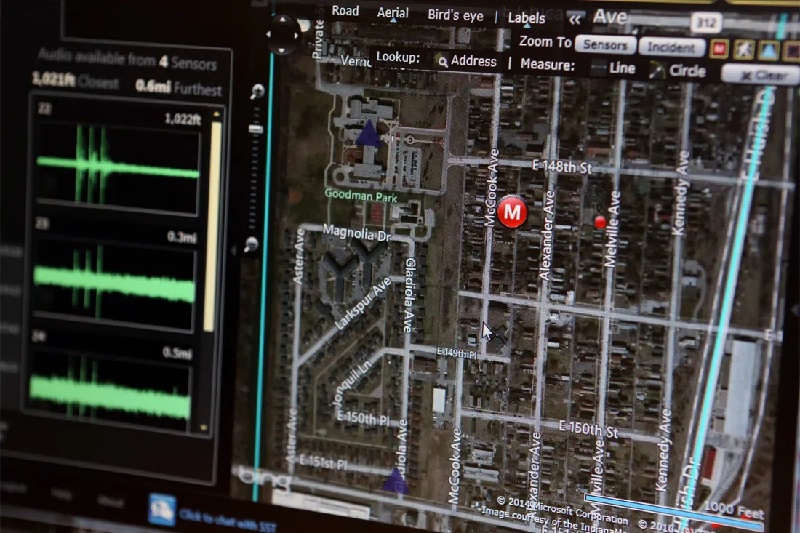
GUNSHOTS RING OUT in a densely populated city neighborhood. Within seconds, based on data from an array of sound sensors deployed in the area, police are able to pinpoint the exact spot where the gunfire happened and dispatch the nearest officers to the scene, giving them a leg up in the race to catch the shooter and help any victims.

It’s hard to imagine why anyone would oppose having that kind of technological aid in the public-safety toolkit. But the evidence supporting gun detection technology, which has landed in scores of US cities, is not nearly that clear-cut, with the most comprehensive study to date suggesting it confers no public safety benefit.

Across the country, critics are raising questions about the impact of the high-tech gunfire locators on the heavily minority communities where they tend to be sited, asking whether they actually make those neighborhoods safer or just subject residents to more surveillance. The debate landed in Boston on Monday, where Police Commissioner Michael Cox faced tough questions at a City Council budget hearing about the city’s use of ShotSpotter, the brand name of the gun detection system the city has used since 2007.

Cox told councilors the technology is “how we stay safe” and said it’s crucial to how officers are deployed in some areas.

The accuracy of ShotSpotter is subject to wildly disparate claims.

SoundThinking, the California company that owns ShotSpotter, says the sensors have a 97 percent accuracy rate, and says the technology “saves lives in the places hit hardest by gunfire.”

Government Technology: Study- ShotSpotter Doesn’t Reduce Crime or Shootings

ShotSpotter software might help police get to shootings faster and collect more evidence, but a new study suggests that it doesn’t help reduce crime or shootings, although very few jurisdictions even try to measure its success.

Many cities looking for a solution to the problem of the proliferation of guns and shootings opt to acquire ShotSpotter, software that detects gunshots and alerts authorities.

For the most part, ShotSpotter does just that, but a 911 call study published in January found that if cities were expecting it to reduce shootings or affect the crime rate, they won’t be satisfied with the software.

“What our research found, and other research as well, is that ShotSpotter achieves those intermediate means. So police tend to respond quicker to ShotSpotter alerts than 911 calls on average, police collect more evidence from ShotSpotter calls than 911 calls; however, ShotSpotter does not show any association with reduced crime or increased likelihood that crimes will be solved,” said Eric Piza, a criminal justice and criminology professor at Northeastern University and the principal investigator of the study, titled The Impact of Gunshot Detection Technology on Gun Violence in Kansas City and Chicago: A Multi-Pronged Evaluation, published with a U.S. Justice Department grant.

There has been recent controversy surrounding ShotSpotter, which means at least some people in some of the cities that have deployed ShotSpotter believe it may not be worth it…

ABC News 7: Prince George’s Co. Police Questioned Over Body-Worn Cameras Falling Off During Arrest

WASHINGTON (7News) — 7News I-Team was all over disturbing video coming out of Prince George’s County Police Department involving an officer’s use of force

Cell phone video posted on social media showed Prince George’s County police officer Steven Tucker and another officer struggling with a suspect who was handcuffed. During this incident, both officers had their body cameras fall off.

Tucker lost his camera, not once, but twice.

Tucker grabbed the suspect’s neck during the struggle after the man refused to get in a patrol car’s front seat. They fell and Tucker’s arm ended up on the man’s neck. This was all caught on cell phone video. That video is the only recorded evidence of the actual struggle because Tucker and a second female officer’s body cameras fell off…

ABC News 7: Suspects in Prince George’s are Allowed to Sit in Front Seat of Cop Cars. Is That a Risk?

WASHINGTON (7News) — 7News has discovered a major concern about the Prince George’s County Police Department.

A lack of backseat cages may have led to disturbing incidents of use of force.

It appears that the Prince George’s County Police Department’s lack of back seat cages in their patrol cars in two separate incidents of use of force contributed to things getting out of control very quickly.

There was no back seat cage in 2020 when Officer Steven Tucker was spat on by a handcuffed and belted-in suspect — and Tucker punched the man eight times…

ABC News 7: Second Disturbing Use of Force Video From Inside Prince George’s County Police Dept.

PRINCE GEORGE’S COUNTY, Md. (7News) — Earlier this month, 7News was the first to show you a disturbing video coming out of the Prince George’s County Police Department.

One of its officers hit a suspect eight times in the head after the suspect spit at the officer.

It was ruled justifiable.

Now, 7News has questions about another alarming use of force video involving the same police officer.

Cell phone video posted on X last October showed Prince George’s County Police Officer Steven Tucker grabbing a handcuffed suspect’s neck during a struggle after the man refused to get in a patrol car’s front seat…

ABC News 7: Prince George’s County Officer Hits Suspect 8 Times in Head After Being Spat On

PRINCE GEORGE’S COUNTY, Md. (7News) — 7News obtained a disturbing video of a Prince George’s County police officer and his use of force. Some of the footage is hard to watch and until now, the public has never viewed the video.

Police officers have a very tough job and it’s a dangerous one. We do know if force is used in some arrests.

The exclusive video 7News obtained is from 2020 and showed a very intoxicated suspect spit at Prince George’s County police officer Steven Tucker Jr. while he was driving his patrol car. Tucker reacted by punching the suspect a total of eight times.

Is it the proper use of force? Decide for yourself. But, Prince George’s County Police Department called Tucker’s use of force justifiable…

NBC News Boston: Is ShotSpotter Gunfire Detection Technology Actually Helping our Communities?

When a gunshot goes off, police will tell you seconds matter, which is why for years, the gunshot warning technology called ShotSpotter has been so popular with police departments across the country.

“To know where the incidents of gunshots are taking place and to be able to respond immediately, as quickly as possible, is very important to the city,” Mayor Michelle Wu said Wednesday.

Now, a new report by the ACLU of Massachusetts is raising questions about the effectiveness of ShotSpotter. The ACLU said it analyzed 1,300 reports it obtained from Boston Police for so-called ShotSpotter activations between 2020 and 2022.

“In nearly 70% of cases, Boston Police officers found no evidence of gunfire in response to ShotSpotter alerts,” said Kade Crockford, director of the Technology for Liberty Program at the ACLU of Massachusetts. “The technology is unreliable, it is sending police looking for shooters in communities where there may not have even been a shooting.”

The ACLU has argued before that those police responses, paired with the way human analysis can be applied to the technology, can lead to an infringement on the civil liberties of people who live in the neighborhoods.

Dr. Eric Piza is director of Crime Analysis Initiatives and a professor at Northeastern University. He led what is believed to be the largest study about ShotSpotter, analyzing 15 years of data in Kansas City and Chicago.

“We essentially found the technology offers some procedural benefits, for example police officers arrive on scene a little bit quicker with ShotSpotter calls, however we didn’t find any improvements on public safety,” Piza said. “Shootings did not go down in the ShotSpotter areas after the installation of ShotSpotter, shootings were not any more likely to be solved in either city after the deployment of ShotSpotter.”

Mirror Indy: IMPD Recommended City Contract With ShotSpotter After 2022 Pilot

Roughly 18 months after police officials labeled gunshot detection technology as not “fiscally responsible,” an Indianapolis Metropolitan Police Department working group reversed course and recommended purchasing ShotSpotter services, according to a 2023 report obtained by Mirror Indy.

In 2021, against a backdrop of protesters calling for the city to defund the police, IMPD Deputy Chief Kendale Adams voiced his opposition to a proposal that would have allocated $730,000 to spend on a gunshot detection system.

“One of the things this proposal talks about is ShotSpotter. And we’ve looked at that technology. It’s an expensive technology,” Adams said at a July 2021 meeting of the City-County Council. “It’s continuing to be technology we look at, but at this time, it just would not be fiscally responsible.”

But by the following February, police officials said they would test the use of gunshot detection technology on the east side. That pilot, which aimed to test the capabilities of ShotSpotter and two other vendors, concluded at the end of 2022. Police did not release the results of that study.

Staggered Deployment of Gunshot Detection Technology in Chicago, IL: A Matched Quasi‑Experiment of Gun Violence Outcomes

Nathan T. Connealy, Eric L. Piza, Rachael A. Arietti, George O. Mohler, and, Jeremy G. Carter (2024)

Journal of Experimental Criminology

Key Takeaways

  • Chicago’s Gunshot Detection Technology (GDT) coverage area expanded from approximately 3 square-miles to over 136 square-miles between 2012 and 2018
  • A staggered synthetic control design was used to test the effect of GDT on gun violence occurrence across the aggregate, initial, expanded, and phase-specific deployment periods
  • Gun recoveries significantly increased in GDT coverage areas in the aggregate, initial, and expanded models and in several phase-specific models relative to controls
  • GDT had no effect on fatal shootings, non-fatal shootings, general part I gun crime, or shots fired calls for service in any models.
  • The results align with prior literature that has found a procedural benefit, but not a prevention benefit, of GDT

Research Summary

Gunshot detection technology (GDT) functions through a network of acoustic sensors that detect sounds from firearm muzzle blasts that can be audibly distinguished from other loud noises. GDT provides a way for law enforcement to respond to shots fired events without relying on citizen calls for service, which may be plagued by inconsistencies such as inaccurate information or failure to report.

The current study examines potential GDT effects in Chicago, IL. Chicago Police Department (CPD) first deployed GDT in a pilot phase in September 2012, covering an approximately 3-square mile area. In 2017, CPD began extending GDT coverage across the city through ten additional deployment phases (11 total), which brought the coverage area to over 136 square-miles. The cost of Chicago’s current GDT coverage area is between $8.8 and $12.3 M annually based upon on the advertised annual subscription cost of between $65 and $90 K per square mile for the ShotSpotter system.

Chicago Mayor Brandon Johnson partially campaigned on a promise to terminate the City’s ShotSpotter contract, citing concerns the system was unreliable, overly susceptible to human error, and played a pivotal role in the police killing of 13-year-old Adam Toledo. Johnson delivered on his promise on February 13, 2024, by announcing his decision to discontinue the use of ShotSpotter, with a phasing out of the technology set to begin September 2024.

The current analysis measure changes in gun violence outcomes using a quasi-experimental design with an empirically derived control group through synthetic control matching techniques. The approach ensures that GDT target areas are effectively matched to approximately equivalent control areas for comparison through the sequencing of empirical covariates in a synthetic control matching model. The unique GDT deployment phases in Chicago were then evaluated for aggregate, initial and expanded, and phase-specific treatment effects using difference-in-difference analyses.

The results demonstrate that GDT did not significantly impact fatal shootings, nonfatal shootings, part I gun crimes, or shots fired calls for service. This result was observed across aggregate average treatment effects conditioned dynamically over time, initial effects of GDT deployment in phase one, expanded effects of GDT deployment in phases 2–11, and in most individual phase-specific effects.

GDT did lead to increased levels of gun recoveries, with results indicating GDT targeted police districts experienced about 11.17% (aggregate), 8.29% (initial), and 12.28% (expanded) more gun recoveries than control units. The phase-specific models indicate that the general pattern reflected significant gun recovery increases across phases. However, a few phases also produced insignificant or bi-directional effects. A cursory review of the non-significant phases indicates that many were later-stage deployments (phases 7, 8, 9, and 11) and may have reflected target areas with comparatively lower levels of gun violence that are less likely to be subjected to additional enforcement strategies.

The results align with prior literature that has found a procedural benefit, but not a crime prevention benefit, of gunshot detection technology.