Chicago Tribune: With ShotSpotter Staying in Chicago for the Time Being, Dispute Continues Over the System’s Usefulness

Early one morning last May, on a bungalow-lined street in Avalon Park, ShotSpotter detected real gunshots: more than half a dozen rounds fired.

It was a busy night, and officers didn’t make it to the scene for more than half an hour. But when they arrived they found 24-year-old Aréanah Preston, a Loyola law student and Chicago police officer, fatally shot on her front lawn.

Late one night in January, on a residential block of Auburn Gresham, ShotSpotter detected what likely were just fireworks.

But the alert sent officers out looking for a shooter, and when they got there they heard a loud bang. One officer opened fire in the direction of a boy who had just set off a firecracker, but did not hit him…

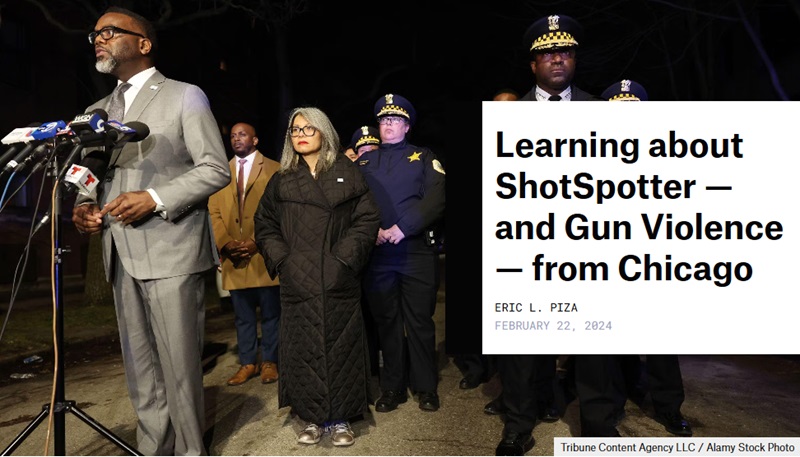
Vital City: Learning about ShotSpotter — and Gun Violence — from Chicago

Research shows the technology doesn’t reduce shootings or increase clearance rates, but it may have other benefits.

On February 13, Chicago Mayor Brandon Johnson announced that the city’s ShotSpotter gunshot detection system would be discontinued, with a phasing out of the technology set to begin this September. ShotSpotter is the global leader in gunshot detection technology — a network of acoustic sensors that pinpoints the location of gunfire and typically alerts the police quicker than 911 calls. SoundThinking, ShotSpotter’s vendor, reports that over 250 agencies worldwide (including the NYPD) have adopted their platform. Chicago initially installed ShotSpotter in September 2012 within an approximately three-square-mile area, with coverage expanding to 136 square miles by May 2018. Annual costs advertised on the SoundThinking website ranged from $8.8 to $12.3 million per year for maintaining this coverage…

Springer Nature: Breaking barriers: Dr. Eric L. Piza’s evolution from an undergrad researcher to open access crusader in crime analysis and policing

As an undergraduate at Rutgers University, Dr. Eric L. Piza stumbled upon an opportunity that would shape his career trajectory: a flier for research assistant positions at the Police Institute, under the guidance of Professor George Kelling. Little did he know that this experience would discover a world of collaborative problem-solving, crime analysis, and research that would become the cornerstone of his professional life. Learn more about Dr. Piza’s perspectives on the transformative power of open access (OA), his experiences with OA publishing agreements, and the pivotal role he envisions for research in promoting social justice and influencing public dialogue.

Governing: New Policing Strategies and the Challenge of Implementation

The policing profession spends a lot of time discussing and studying programs and policies, and less time thinking about how they’re implemented. Why can a program that’s effective in one city be a disaster in another city? How much of a program or policy’s effectiveness can be attributed to the way it was implemented?

At the recent American Society of Criminology conference in Philadelphia, our organization convened a panel discussion on implementation with practitioners and academics. I want to share a few highlights from the session.

Former Camden County, N.J., Chief Scott Thomson discussed his experience implementing the Integrating Communications, Assessment and Tactics training program. One lesson he learned was that it’s important that the change not be optional. He made it part of the agency’s policy, and there were consequences for not following agency policy…

KMBC News 9: New Study Questions Effectiveness of Gunfire Detection System Used by KCPD

KANSAS CITY, Mo. —
A newly released study found that the gunfire detection system the Kansas City, Missouri Police Department has been using since 2012 hasn’t reduced any violent crime categories.

The study published in the Journal of Experimental Criminology looked at data both before and after the technology was installed.

“Also, shootings that occurred within the target area were not any more likely to be solved than shootings that occurred in other areas of the city,” Dr. Eric Piza, a researcher for the study, said.

Kansas City uses an audio detection system called ShotSpotter.

The system is designed to notify KCPD more quickly than a 911 call and identify the location of the gunfire.

Sergeant Jake Becchina says KCPD’s internal study found that 70 percent of the time, nobody calls when there’s outdoor gunfire…

NPR Kansas City: ShotSpotter Gunshot Detection System Fails to Reduce Violent Crime in Kansas City, Study Says

The Kansas City Board of Police Commissioners recently approved spending $200,000 for another year of ShotSpotter, a surveillance technology, despite a new study that says it doesn’t achieve the city’s public safety goals.
An audio surveillance technology the Kansas City Police Department uses to detect the location of gunshots has failed to reduce violent crime, a new study says.

An academic research project funded by the National Institute of Justice found that the use of ShotSpotter, a gunshot detection technology, resulted in a few benefits but didn’t meet its original goal of increased prosecutions of gun-related crime.

ShotSpotter is an “acoustic surveillance technology,” according to its manufacturer, with audio sensors placed in strategic areas — typically on rooftops or utility poles — that detect gunfire, locate the area, then send the real-time data to police via 911, officers’ desktops, smart phones or smart watches.

Kansas City has used ShotSpotter since 2012, a decade when the city’s homicide rate repeatedly set records.

Still, the Kansas City Board of Police Commissioners is sticking with ShotSpotter — for now. In September, the board approved nearly $200,000 for a one-year renewal of a contract with SoundThinking, Inc., the maker of the ShotSpotter system, which will run from October 2023 through September 2024.

But during a meeting in October, some commissioners waffled over continuing to use ShotSpotter. Commissioner Dawn Cramer suggested dropping the program so they could use the money to increase officers’ salaries.

The study, lead by Dr. Eric L. Piza, a professor in the School of Criminology and Criminal Justice at Northeastern University, looked back to the start of the program in 2012 and analyzed three years of data…

The Effect of Gunshot Detection Technology on Evidence Collection and Case Clearance in Kansas City, Missouri

Eric L. Piza, Rachael A. Arietti, Jeremy G. Carter, and George O. Mohler (2023)

Journal of Experimental Criminology

*This study was funded by the National Institute of Justice (grant number 2019-R2-CX0004)

Key Takeaways

  • This study tests whether (1) shots fired calls for service in the gunshot detection technology (GDT) target area are more likely to be classified as unfounded; (2) police responses to shootings in the GDT target area are more likely to recover ballistic evidence or firearms; and (3) shootings in the GDT target area are more likely to be cleared
  • Shots fired calls for service in the GDT target area were 15% more likely to be unfounded
  • For fatal shootings, GDT treatment was not associated with increased likelihood of ballistic evidence collection or case clearance
  • For non-fatal shootings, GDT treatment was not associated with increased likelihood of ballistic evidence collection, gun recovery, or case clearance
  • GDT may not add value to investigations and may increase patrol workload

Research Summary

Clearance rates have long been used as a measure of police performance and effectiveness, reflecting the importance of incapacitation in disrupting patterns of violence and creating a general deterrence effect, and the public desire to deliver justice to crime victims and their families. Research relating to the level to which technology improves case clearance are highly mixed, with technology improving investigative function in certain cases but not others.

Gunshot detection technology (GDT) has become a central component of police efforts to respond to and investigate gun violence. Over 250 public safety agencies worldwide have adopted the ShotSpotter platform developed by SoundThinking, the global industry leader in GDT. The majority of evaluation studies have explored GDT’s crime prevention capacity, despite the technology arguably offering more potential for investigative police functions. The few studies that have focused on GDT’s impact on investigative outcomes, such as evidence collection and case clearance, have generated little consensus.

The current study evaluates GDT’s effect on evidence collection and case clearance in Kansas City, MO. The Kansas City Police Department (KCPD) installed SoundThinking’s ShotSpotter GDT system in September 2012, with the target area covering approximately 3.5 square miles of the city. Kansas City pays between $227,500 and $315,000 per year for their ShotSpotter system based on the advertised annual subscription cost of between $65K and $90K per square mile. The system detected 11,517 gunfire events through the end of 2019, the final year of our study period.

We used the entropy balancing method to conduct a matched case–control evaluation. Entropy balancing is a quasi-experimental design that matches treatment and control units by reweighting covariates based on propensity for treatment. The sum of the control unit weights equals the total number of cases in the treated group. Eighteen covariates were used in the entropy matching algorithm to create a weighted control group that mirrors the treatment group across relevant measures. The influence of GDT was tested through logistic regression models incorporating the weights from the entropy matching procedure. The entropy weights were incorporated as probability weights in the logistic regression models.

Results indicate that shots fired calls for service in the GDT target area have a 15% increased likelihood of being unfounded as compared to the control group. Fatal shooting incidents in the GDT target area were no more likely to result in collection of ballistic evidence for NIBIN analysis, or subsequent case clearance, as compared to incidents in the control area. Non-fatal shooting incidents in the GDT target area were no more likely to result in collection of ballistic evidence for NIBIN analysis, the recovery of firearms, or subsequent case clearance, as compared to incidents in the control area.

The current study did not find support for GDT as an investigatory tool for either fatal or non-fatal shooting incidents. The increased likelihood of unfounded shots fired cases has important implications for GDT use by police. This reflects increased workload of police responding to incidents where gunfire was not confirmed.

Gunshot Detection Technology Effect on Gun Violence in Kansas City, Missouri: A Microsynthetic Control Evaluation

Eric L. Piza, David N. Hatten, George O. Mohler, Jeremy G. Carter, and Jisoo Cho (2023)

Criminology & Public Policy

*This study was funded by the National Institute of Justice (grant number 2019-R2-CX0004)

Key Takeaways

  • Gunshot detection technology (GDT) was associated with ~30% higher levels of ballistic evidence collection in the GDT target area and surrounding catchment area
  • GDT was associated with ~30% higher levels of gun recoveries in the surrounding catchment area
  • GDT was associated with ~22% lower levels of shots fired calls for service in the GDT target area
  • GDT did not influence any of the gun violence categories involving confirmed victims (non-fatal shootings, fatal-shootings, and aggravated assaults/robberies committed with a firearm)
  • Agencies that prioritize gun violence reduction—rather than reducing calls for shots fired or increasing ballistic evidence collection—should consider if resources are better used for solutions other than GDT

Research Summary

Gunshot detection technology (GDT) has recently emerged as a core entry into the suite of technological gun violence prevention solutions incorporated by police. Despite increased popularity of the technology, the research evidence on GDT is underdeveloped, especially as compared to other police technologies. While certain GDT studies have taken efforts to select control areas with similar crime and sociodemographic conditions as the target areas, this is not commonplace in GDT research. Furthermore, such research has used a fuzzy matching approach where control areas are selected based on their general similarity with target areas rather than through quantitative matching techniques that ensure statistical equivalency between treatment and control areas.

The current study aims to contribute to the knowledge on GDT effect on crime occurrence through a rigorous evaluation of the technology in Kansas City, MO. The Kansas City Police Department installed SoundThinking’s ShotSpotter GDT system in September 2012, with the target area covering approximately 3.5 square miles of the city. Kansas City pays between $227,500 and $315,000 per year for their ShotSpotter system based on the advertised annual subscription cost of between $65K and $90K per square mile. The system detected 11,517 gunfire events through the end of 2019, the final year of our study period.

We apply the recently developed microsynthetic control method in the evaluation, incorporating over 13 years of data. The microsynthetic control method modifies the synthetic control method for application to micro-geographic units of analysis. The control group was specified to match the GDT target area across 18 covariates.

Both process and outcome measures were tested in the analysis. Process measures included gun recoveries and NIBIN ballistic evidence collection to reflect the enforcement-related causal mechanisms of GDT. Outcome measures included shots fired calls for service, non-fatal shootings, fatal shootings, and gun assaults and robberies. The statistical analysis was conducted for both the GDT target area to measure main effects and a surrounding catchment area to measure spatial displacement effects.

The collection of NIBIN ballistic evidence was significantly higher by approximately 30% compared to the weighted control area in both the GDT target area (476 vs. 365) and catchment area (351 vs. 271). Gun recoveries were nearly 13% higher in the catchment area than the weighted control area (1,668 vs. 1,477). Shots fired calls for service were approximately 22% lower in the GDT target area than the weighted control area (5,665 vs. 7,285). Importantly, none of the three crime types involving confirmed victims (fatal shootings, non-fatal shootings, gun assaults and robbery) exhibited any significant changes following the installation of GDT in either the target area or catchment area.

Overall, the study results do not offer much empirical support for GDT as a gun violence prevention tool in Kansas City. Agencies that highly prioritize increasing evidence collection and reducing unauthorized firearm discharges may consider dedicating necessary resources to acquire GDT. Agencies that prioritize the reduction of gun violence victimization, however, should consider whether resources are better used for solutions other than GDT.

The Impact of Gunshot Detection Technology on Gun Violence in Kansas City and Chicago: A Multi-Pronged Synthetic Control Evaluation

2020-2023

Funder: National Institute of Justice
($503,129)

Principal Investigator: Eric L. Piza

Co-Principal Investigators: Jeremy G. Carter & George O. Mohler

Project Overview

This quasi-experimental longitudinal interrupted time series project will evaluate the Gunshot Detection Technology (GDT) systems (ShotSpotter) in Kansas City, MO, and Chicago, IL using a synthetic control group approach to improve comparability. Both cities installed their GDT systems in 2012, which will allow for a comparison of relevant outcome measures in the 7-year post-GDT period (2012 – 2019) to the 7-year pre-GDT period (2005 – 2011). Because of differences in how GDT was deployed in Chicago and Kansas City, the project team will be able to determine the effect associated with the initial deployment of GDT in Kansas City and the continuous expansion of GDT coverage in Chicago.

Four distinct research questions will be explored for both KCPD and CPD: 1) What effect does GDT have on officer responses to and time spent on gunfire scenes? 2) What effect does GDT have on the collection of ballistic evidence? 3) What effect does GDT have on the occurrence of gun crimes? and 4. What effect does GDT have on criminal investigations (i.e., case closure) of gun crimes?

Project Publications

NGN: Stores are Locking Up Everyday Goods. Is Organized Retail Theft on the Rise?

Socks, cold medicine, even deodorant. Going to Target or CVS these days to grab essentials is a little more complicated as retailers lock up everyday goods in an effort to curb shoplifting. It’s enough to get shoppers frustrated and wondering “Is all this really necessary?”

Just how much shoplifting and organized retail crime is hurting stores is somewhat up for debate. Target announced last week that it is closing nine stores due to theft and organized retail crime. The corporation said Oct. 21 will mark the last day in business for some stores in Seattle; Portland Oregon; Oakland, California; San Francisco; and the Harlem neighborhood of New York City.

“We cannot continue operating these stores because theft and organized retail crime are threatening the safety of our team and guests, and contributing to unsustainable business performance,” Target said in a press release. “We know that our stores serve an important role in their communities, but we can only be successful if the working and shopping environment is safe for all.”