
When Crime Moves Where Does It Go? Analyzing the Spatial Correlates of Robbery Incidents Displaced by a Place-based Policing Intervention
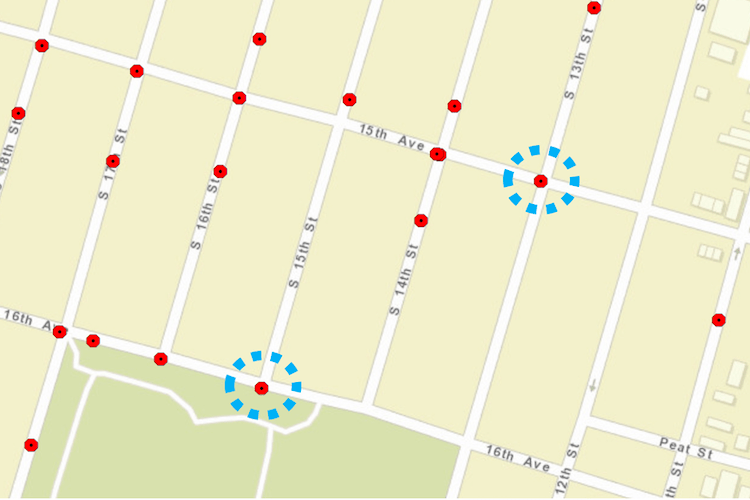
David N. Hatten & Eric L. Piza (2021)
Journal of Research in Crime & Delinquency

Key Takeaways
- This study examined the place-based factors associated with robbery displacement caused by a foot-patrol intervention in Newark, NJ
- Relationships between displaced crime and environmental factors did not always appear in the expected direction
- Bus stops and non-local roads predicted increased levels of spatial displacement
- Residential mobility predicted increased levels of temporal displacement in the catchment area
- Corner stores predicted decreased levels of temporal displacement in the target area
- Police enforcement actions predicted increased levels on temporal displacement
Research Summary
There is a well-documented belief among some police practitioners that, despite their best efforts, crime will simply move to another area and/or time in response to targeted crime prevention interventions. While much empirical research reports that crime displacement is rare, a number of other studies indicate the absence of displacement is far from guaranteed. Based on prior reviews of the research literature, 26% of studies reported displacement effects of some kind, a sizable minority.
The current study contributes to the literature on crime displacement through a follow-up analysis of the Newark Police Department’s (NPD’s) Operation Impact, a foot-patrol intervention. The original evaluation of Operation Impact found the foot patrols generated a significant reduction of overall violence, but robbery suffered from both spatial and temporal displacement. The current analysis focuses on street segments comprising the Operation Impact target area, control area, and catchment zone (used to measure spatial displacement). On each street segment, crime generators and attractors (CGAs) (bus stops, corner stores, known gang territory, at-risk housing complexes, and non-local roads), household-level measures of disadvantage (poverty, residential mobility, and home ownership), and crime incidents were measured. Regression models then tested the level to which each CGA and household characteristic influenced the spatial and temporal displacement of robbery.
Three separate analyses were conducted. Model 1 focused on post-intervention robbery activity in the catchment area. Model 2 focused on both spatially and temporally displaced crime by testing the effect on crime in the catchment area occurring during non-operational hours of the intervention. Model 3 tested the effect on temporal displacement, focusing on crime in the target area during the non-operational hours.
Model 1 found that robbery increased 35% within catchment area street segments containing a bus stop. This contrasts with the effect of bus stops in the study area generally, with the presence of bus stops associated with a 15% decrease in robbery. Non-local roads in the catchment area were associated with a 25% increase in robbery levels. However, non-local roads were also associated with heighted robbery levels throughout the study area.
Model 2 found that robbery activity increased 24% during non-operational time periods within the catchment area street segments containing bus stops. Throughout the entire study area bus stops were again associated with decreased robbery levels. During non-operational periods, residential mobility was associated with an 8% robbery increase in catchment area street segments. Residential mobility did not have a significant effect on robbery in the study area as a whole.
Model 3 found that robbery activity decreased 28% in target area street segments containing a corner store during non-operational time periods. Corner stores were associated with 14% increase in robbery levels during non-operational hours throughout the entire study area. Every 1 standard deviation increase in NPD enforcement actions resulted in a 4% increase of robbery in target area street segments during non-operational time periods.
The findings support the notion that specific features of the environment can influence the occurrence of displacement, even if they do not influence the occurrence of crime more generally.
NBC News: Police Fired 24 shots at a handcuffed man. Why didn’t they turn on their body cameras?

It has been almost a year and a half since Ariane McCree was shot dead by police in a Walmart parking lot, handcuffed and in possession of a gun, but his family still has a host of unanswered questions.
McCree, 28, had raced out of the Walmart in Chester, South Carolina, a small town an hour north of Columbia, after he was placed in handcuffs when he was accused of stealing a $45 lock in November 2019, police said.
But exactly what happened next remains unclear in part because the responding officers didn’t activate their body cameras until after McCree, a Black father and former high school football star, was gunned down in a hail of police bullets.
“A lot of things do not add up,” his cousin, Tabatha Strother, told NBC News. “But we would have known a lot of this if the bodycam was on.”
Syracuse.com: Sheriff Conway refuses body cameras while more U.S. police forces embrace them

In Onondaga County, at least 10 of the county’s 15 police departments — including the Syracuse Police Department — use the cameras.
But the Onondaga County Sheriff’s Office, the second-largest police force in the county, does not use body cameras and has no plans to add them.
Why?
It’s not a priority, Sheriff Eugene Conway told Syracuse.com | The Post-Standard.
Conway said the cameras are expensive and he wants to spend money on other things such as bulletproof vests, stun guns and patrol cars as well as filling empty positions. The sheriff said there are no discussions or plans under way to add body cameras.
“Body cameras are important,” Conway said. “But where do they fall in the overall necessity?”
WSHU Public Radio: Advocates call Suffolk County’s long hidden body camera policy ‘useless’

After much resistance, Suffolk County publicly released its policy on how it uses body cameras. The long-sought policy raises several concerns for civil rights advocates, experts, and lawmakers. The release comes three weeks after police officers were seen on a body camera kicking a handcuffed suspect.
The policy allows police officers to view footage before writing an arrest report, doesn’t explicitly require supervisors to view footage after a major incident, and gives officers discretion when to use — or not use — the camera.
Irma Solis, the director of the Suffolk chapter of New York Civil Liberties Union, says giving police the discretion to turn the cameras on or off makes them “useless.”
“If they are given the discretion to activate it or not, the likelihood of them using their discretion to not turn it on is much higher,” she said.
In an interview, she said a better policy would have less “wiggle room” and more explicitly state when police are required to activate the camera during interactions with the public.
“Because we’re able to see everything that happened, not just what the officer wanted us to see,” Solis said…
Chicago Sun Times: Former suburban cop hopes to cash in on new body-camera law in Illinois

A former suburban cop aims to capitalize on a new Illinois justice reform law that will require every officer in the state to have a body camera by 2025.
Ben Laird retired about three years ago as a River Forest police detective. Now, Laird, who has an MBA and a college degree in information services, runs Frontline Public Safety Solutions, which sells software to police departments around the country — including its latest product, a computer platform for police supervisors to audit body-camera footage.
Dozens of suburban Chicago departments have signed up, according to Laird, who says his system lets them see which officers need training or discipline…
IPVM: CCTV Researcher Eric Piza Interviewed

Few academic researchers study video surveillance / CCTV. One of the most notable is John Jay College of Criminal Justice, City University of New York associate professor Dr. Eric Piza who we interviewed. This interview is part of a running series of IPVM interviews of professionals of note. For previous IPVM interview coverage, please see…
IPVM Surveillance News source: Mexico City Public Video Surveillance Faces Scrutiny

Do large-scale, multimillion-dollar safe city projects stop crime? If not, what is the point in selling the cameras in the first place?
Tens of thousands of video surveillance cameras are currently operational in Mexico City and the adjacent State of Mexico. IPVM interviewed industry and local sources and examined official Mexican crime statistics, finding no clear link between more cameras and less crime, despite politicians’ promises to the contrary.
This post is part of IPVM’s expanded Latin America coverage. For recent IPVM Mexico coverage, please see…
Scripting Police Escalation of Use of Force Through Conjunctive Analysis of Body-Worn Camera Footage: A Systematic Social Observational Pilot Study
Victoria A. Sytsma, Vijay Chillar, & Eric L. Piza (2021)
Journal of Criminal Justice
*This study was funded by the Charles Koch Foundation, Policing and Criminal Justice Reform program
Key Takeaways
- Body-camera footage and video data analysis enable the in-depth observation of officer, suspect, and by-stander behavior
- Conjunctive analysis of case configurations is a promising method for script analysis
- Dominant police officer action configurations include procedurally just interactions
- Evidence of suspect impairment was an important contributor to risk of force escalation
- Presence of a victim may inflame the situation
- Non-antagonistic bystanders may civilize the situation
- The highest risk configurations include older police officers
Research Summary
Crime scripts organize crime events into sequential stages leading to a specifiable goal. This creates a procedural script that provides a functional explanation of the behavior in question. More recent research has broadened script analysis to include subject actions, targets of such actions, as well as the totality of the relevant environment, situation or setting.
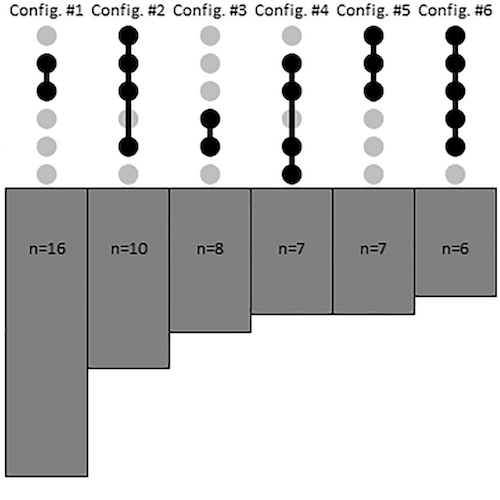
This exploratory study uses script analysis to describe a series of varying dominant configurations of choice-structuring properties related to escalation of police use of force. We rely on systematic social observation (SSO) of police use of force cases captured on police body-worn cameras to identify actions and environmental characteristics present during the use of force event. We then use conjunctive analysis of case configurations (CACC) to identify dominant case configurations of police officer and suspect actions, demographic characteristics, and environmental characteristics. CACC was also used to determine the relative risk of use of force escalation from soft empty-hand force to more severe forms of force based on case configuration.
The study sample consists of 91 use of force events recorded by BWCs between December 2017 through the end of 2018. Use of force events include a period of time preceding and following the use of force incident(s), beginning when the officers are first visibly seen interacting with any involved parties (e.g., suspects, bystanders, or victims). The end of the use of force event can be described as the time at which full suspect compliance is secured, making the likelihood of physical force minimal. We classified 18 variables across three classifications: officer action points, suspect actions points, and environmental characteristics. Video data was supplemented by NPD arrest records to ascertain gender, ethnicity, and age of officers and suspects.
Results indicate that the overall escalation risk (from open hand use of force to more serious use of force) was 63.74%. Two of the dominant officer action configurations surpass this overall risk substantially and both include officers giving a shout command, with and without also giving a calm command. The officer action profile with lowest risk of force escalation is also the profile containing the most actions indicative of a procedurally just interaction. These results point to the efficacy of officer use of persistent calm commands and behaving in a procedurally just manner for reducing risk of escalation.
Evidence of drug or alcohol impairment of the suspect appears to be one of the most important contributors to risk of escalation. Suspect physical antagonism does not predict escalation when elements such as weapon, suspect flee, and suspect drug or alcohol impairment are also absent. While daytime may elevate risk of escalation, such an effect may be mitigated by the presence of a non-antagonistic bystander. These results suggest that certain types of bystanders can have a civilizing effect on suspects.
The highest risk configurations include older officers and the lowest risk profiles include younger officers. Older or more experienced officers may be resistant or not exposed to cultural shifts in policing, as well as procedural justice and crisis intervention training. However, although older officers increase risk of escalation, when those officers are white, the risk decreases to below the overall risk of escalation.
Police Officers’ Best Friend?: An Exploratory Analysis of the Effect of Service Dogs on Perceived Organizational Support in Policing
Kenneth M. Quick & Eric L. Piza (2021).
The Police Journal: Theory, Practice and Principles
Abstract
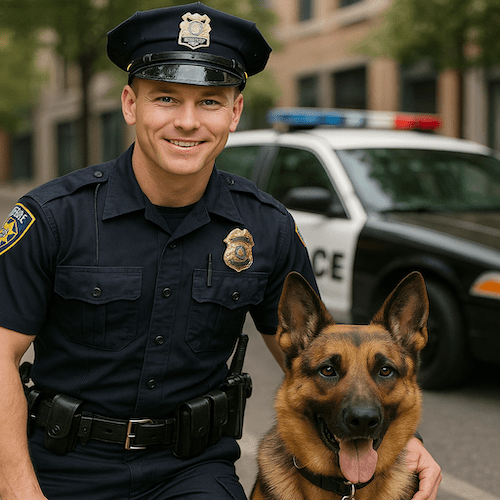
This study explored the effectiveness of a novel technique for police departments to support their officers and promote wellness: the use of service dogs. We evaluated officer perceptions in two mid-sized, municipal police departments that have wellness programs with a service dog that is permanently assigned to a full-time police officer handler: Groton and Naugatuck, Connecticut. We assessed six factors believed to influence police officer wellness including: operational and organizational stress using the Police Stress Questionnaire; topical stressors including those related to the COVID-19 pandemic, police use of force and community relations, and police reform efforts; Perceived Organizational Support (POS); receptivity to service dogs; and willingness to seek as- sistance for mental health issues. We found evidence that exposure to service dogs is significantly linked to both POS and receptivity to service dogs in policing. We also found that officer willingness to seek their department’s assistance regarding mental health approaches significance with greater exposure to the service dog (p = .07). Although we found no significant evidence that exposure to service dogs is linked to stress reduction, we found that police reforms pose a substantial perceived stress on officers in the study. This finding presents a serious challenge for reformers that risks undermining officer wellness. Implications of our findings and recommendations for future research are discussed.
 Eric L. Piza, Ph.D.