NBC News Boston: Is ShotSpotter Gunfire Detection Technology Actually Helping our Communities?

When a gunshot goes off, police will tell you seconds matter, which is why for years, the gunshot warning technology called ShotSpotter has been so popular with police departments across the country.

“To know where the incidents of gunshots are taking place and to be able to respond immediately, as quickly as possible, is very important to the city,” Mayor Michelle Wu said Wednesday.

Now, a new report by the ACLU of Massachusetts is raising questions about the effectiveness of ShotSpotter. The ACLU said it analyzed 1,300 reports it obtained from Boston Police for so-called ShotSpotter activations between 2020 and 2022.

“In nearly 70% of cases, Boston Police officers found no evidence of gunfire in response to ShotSpotter alerts,” said Kade Crockford, director of the Technology for Liberty Program at the ACLU of Massachusetts. “The technology is unreliable, it is sending police looking for shooters in communities where there may not have even been a shooting.”

The ACLU has argued before that those police responses, paired with the way human analysis can be applied to the technology, can lead to an infringement on the civil liberties of people who live in the neighborhoods.

Dr. Eric Piza is director of Crime Analysis Initiatives and a professor at Northeastern University. He led what is believed to be the largest study about ShotSpotter, analyzing 15 years of data in Kansas City and Chicago.

“We essentially found the technology offers some procedural benefits, for example police officers arrive on scene a little bit quicker with ShotSpotter calls, however we didn’t find any improvements on public safety,” Piza said. “Shootings did not go down in the ShotSpotter areas after the installation of ShotSpotter, shootings were not any more likely to be solved in either city after the deployment of ShotSpotter.”

Mirror Indy: IMPD Recommended City Contract With ShotSpotter After 2022 Pilot

Roughly 18 months after police officials labeled gunshot detection technology as not “fiscally responsible,” an Indianapolis Metropolitan Police Department working group reversed course and recommended purchasing ShotSpotter services, according to a 2023 report obtained by Mirror Indy.

In 2021, against a backdrop of protesters calling for the city to defund the police, IMPD Deputy Chief Kendale Adams voiced his opposition to a proposal that would have allocated $730,000 to spend on a gunshot detection system.

“One of the things this proposal talks about is ShotSpotter. And we’ve looked at that technology. It’s an expensive technology,” Adams said at a July 2021 meeting of the City-County Council. “It’s continuing to be technology we look at, but at this time, it just would not be fiscally responsible.”

But by the following February, police officials said they would test the use of gunshot detection technology on the east side. That pilot, which aimed to test the capabilities of ShotSpotter and two other vendors, concluded at the end of 2022. Police did not release the results of that study.

Staggered Deployment of Gunshot Detection Technology in Chicago, IL: A Matched Quasi‑Experiment of Gun Violence Outcomes

Nathan T. Connealy, Eric L. Piza, Rachael A. Arietti, George O. Mohler, and, Jeremy G. Carter (2024)

Journal of Experimental Criminology

Key Takeaways

  • Chicago’s Gunshot Detection Technology (GDT) coverage area expanded from approximately 3 square-miles to over 136 square-miles between 2012 and 2018
  • A staggered synthetic control design was used to test the effect of GDT on gun violence occurrence across the aggregate, initial, expanded, and phase-specific deployment periods
  • Gun recoveries significantly increased in GDT coverage areas in the aggregate, initial, and expanded models and in several phase-specific models relative to controls
  • GDT had no effect on fatal shootings, non-fatal shootings, general part I gun crime, or shots fired calls for service in any models.
  • The results align with prior literature that has found a procedural benefit, but not a prevention benefit, of GDT

Research Summary

Gunshot detection technology (GDT) functions through a network of acoustic sensors that detect sounds from firearm muzzle blasts that can be audibly distinguished from other loud noises. GDT provides a way for law enforcement to respond to shots fired events without relying on citizen calls for service, which may be plagued by inconsistencies such as inaccurate information or failure to report.

The current study examines potential GDT effects in Chicago, IL. Chicago Police Department (CPD) first deployed GDT in a pilot phase in September 2012, covering an approximately 3-square mile area. In 2017, CPD began extending GDT coverage across the city through ten additional deployment phases (11 total), which brought the coverage area to over 136 square-miles. The cost of Chicago’s current GDT coverage area is between $8.8 and $12.3 M annually based upon on the advertised annual subscription cost of between $65 and $90 K per square mile for the ShotSpotter system.

Chicago Mayor Brandon Johnson partially campaigned on a promise to terminate the City’s ShotSpotter contract, citing concerns the system was unreliable, overly susceptible to human error, and played a pivotal role in the police killing of 13-year-old Adam Toledo. Johnson delivered on his promise on February 13, 2024, by announcing his decision to discontinue the use of ShotSpotter, with a phasing out of the technology set to begin September 2024.

The current analysis measure changes in gun violence outcomes using a quasi-experimental design with an empirically derived control group through synthetic control matching techniques. The approach ensures that GDT target areas are effectively matched to approximately equivalent control areas for comparison through the sequencing of empirical covariates in a synthetic control matching model. The unique GDT deployment phases in Chicago were then evaluated for aggregate, initial and expanded, and phase-specific treatment effects using difference-in-difference analyses.

The results demonstrate that GDT did not significantly impact fatal shootings, nonfatal shootings, part I gun crimes, or shots fired calls for service. This result was observed across aggregate average treatment effects conditioned dynamically over time, initial effects of GDT deployment in phase one, expanded effects of GDT deployment in phases 2–11, and in most individual phase-specific effects.

GDT did lead to increased levels of gun recoveries, with results indicating GDT targeted police districts experienced about 11.17% (aggregate), 8.29% (initial), and 12.28% (expanded) more gun recoveries than control units. The phase-specific models indicate that the general pattern reflected significant gun recovery increases across phases. However, a few phases also produced insignificant or bi-directional effects. A cursory review of the non-significant phases indicates that many were later-stage deployments (phases 7, 8, 9, and 11) and may have reflected target areas with comparatively lower levels of gun violence that are less likely to be subjected to additional enforcement strategies.

The results align with prior literature that has found a procedural benefit, but not a crime prevention benefit, of gunshot detection technology.


SVT Nyheter (Swedish): American Scientist says Victims of Gun Violence Did Not Decrease BEcause of ShotSpotter

Tekniken med skottmikrofoner finns sedan tidigare i USA – men det har ifrågasatts hur väl den fungerar trots att larmen når polisen i genomsnitt 1,5 minuter tidigare.

– Offren för vapenvåld minskade inte i varken Kansas City eller Chicago, dessutom löstes inte skjutningar i högre grad, säger forskaren Eric Piza.

Chicago Tribune: With ShotSpotter Staying in Chicago for the Time Being, Dispute Continues Over the System’s Usefulness

Early one morning last May, on a bungalow-lined street in Avalon Park, ShotSpotter detected real gunshots: more than half a dozen rounds fired.

It was a busy night, and officers didn’t make it to the scene for more than half an hour. But when they arrived they found 24-year-old Aréanah Preston, a Loyola law student and Chicago police officer, fatally shot on her front lawn.

Late one night in January, on a residential block of Auburn Gresham, ShotSpotter detected what likely were just fireworks.

But the alert sent officers out looking for a shooter, and when they got there they heard a loud bang. One officer opened fire in the direction of a boy who had just set off a firecracker, but did not hit him…

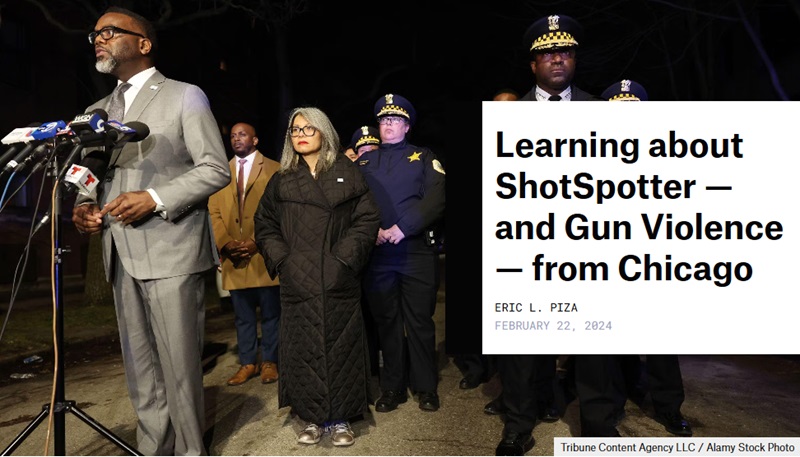
Vital City: Learning about ShotSpotter — and Gun Violence — from Chicago

Research shows the technology doesn’t reduce shootings or increase clearance rates, but it may have other benefits.

On February 13, Chicago Mayor Brandon Johnson announced that the city’s ShotSpotter gunshot detection system would be discontinued, with a phasing out of the technology set to begin this September. ShotSpotter is the global leader in gunshot detection technology — a network of acoustic sensors that pinpoints the location of gunfire and typically alerts the police quicker than 911 calls. SoundThinking, ShotSpotter’s vendor, reports that over 250 agencies worldwide (including the NYPD) have adopted their platform. Chicago initially installed ShotSpotter in September 2012 within an approximately three-square-mile area, with coverage expanding to 136 square miles by May 2018. Annual costs advertised on the SoundThinking website ranged from $8.8 to $12.3 million per year for maintaining this coverage…

Springer Nature: Breaking barriers: Dr. Eric L. Piza’s evolution from an undergrad researcher to open access crusader in crime analysis and policing

As an undergraduate at Rutgers University, Dr. Eric L. Piza stumbled upon an opportunity that would shape his career trajectory: a flier for research assistant positions at the Police Institute, under the guidance of Professor George Kelling. Little did he know that this experience would discover a world of collaborative problem-solving, crime analysis, and research that would become the cornerstone of his professional life. Learn more about Dr. Piza’s perspectives on the transformative power of open access (OA), his experiences with OA publishing agreements, and the pivotal role he envisions for research in promoting social justice and influencing public dialogue.

Governing: New Policing Strategies and the Challenge of Implementation

The policing profession spends a lot of time discussing and studying programs and policies, and less time thinking about how they’re implemented. Why can a program that’s effective in one city be a disaster in another city? How much of a program or policy’s effectiveness can be attributed to the way it was implemented?

At the recent American Society of Criminology conference in Philadelphia, our organization convened a panel discussion on implementation with practitioners and academics. I want to share a few highlights from the session.

Former Camden County, N.J., Chief Scott Thomson discussed his experience implementing the Integrating Communications, Assessment and Tactics training program. One lesson he learned was that it’s important that the change not be optional. He made it part of the agency’s policy, and there were consequences for not following agency policy…

KMBC News 9: New Study Questions Effectiveness of Gunfire Detection System Used by KCPD

KANSAS CITY, Mo. —
A newly released study found that the gunfire detection system the Kansas City, Missouri Police Department has been using since 2012 hasn’t reduced any violent crime categories.

The study published in the Journal of Experimental Criminology looked at data both before and after the technology was installed.

“Also, shootings that occurred within the target area were not any more likely to be solved than shootings that occurred in other areas of the city,” Dr. Eric Piza, a researcher for the study, said.

Kansas City uses an audio detection system called ShotSpotter.

The system is designed to notify KCPD more quickly than a 911 call and identify the location of the gunfire.

Sergeant Jake Becchina says KCPD’s internal study found that 70 percent of the time, nobody calls when there’s outdoor gunfire…

NPR Kansas City: ShotSpotter Gunshot Detection System Fails to Reduce Violent Crime in Kansas City, Study Says

The Kansas City Board of Police Commissioners recently approved spending $200,000 for another year of ShotSpotter, a surveillance technology, despite a new study that says it doesn’t achieve the city’s public safety goals.
An audio surveillance technology the Kansas City Police Department uses to detect the location of gunshots has failed to reduce violent crime, a new study says.

An academic research project funded by the National Institute of Justice found that the use of ShotSpotter, a gunshot detection technology, resulted in a few benefits but didn’t meet its original goal of increased prosecutions of gun-related crime.

ShotSpotter is an “acoustic surveillance technology,” according to its manufacturer, with audio sensors placed in strategic areas — typically on rooftops or utility poles — that detect gunfire, locate the area, then send the real-time data to police via 911, officers’ desktops, smart phones or smart watches.

Kansas City has used ShotSpotter since 2012, a decade when the city’s homicide rate repeatedly set records.

Still, the Kansas City Board of Police Commissioners is sticking with ShotSpotter — for now. In September, the board approved nearly $200,000 for a one-year renewal of a contract with SoundThinking, Inc., the maker of the ShotSpotter system, which will run from October 2023 through September 2024.

But during a meeting in October, some commissioners waffled over continuing to use ShotSpotter. Commissioner Dawn Cramer suggested dropping the program so they could use the money to increase officers’ salaries.

The study, lead by Dr. Eric L. Piza, a professor in the School of Criminology and Criminal Justice at Northeastern University, looked back to the start of the program in 2012 and analyzed three years of data…